


The Indian government announced a New Education Policy on 5th August, which proposed extensive changes in various sectors of Indian education. Until now, India had been following an education policy from 1986, which means changes introduced by the NEP are necessary for the country’s relevance in the education scenario. The new education policy aims to cut back on the vast syllabus to retain the “core essentials” and focus on “experiential learning and critical thinking.”
In that context, the government also announced that coding will be in schools from class 6 onwards. In this article, we will take a look at how this decision will affect young learners but first let’s find out what coding is and what is the appropriate age to learn to code:
What is Coding
Just as we have a wide variety of languages to communicate with each other, computers, too, have a set of languages based on which they conduct their programs. Coding is the process of using such programming languages to give computers instructions on performing actions. At its core, coding is the way humans command, guide, instruct and communicate with machines.
In this rapidly changing computer-run world where technology dictates the next developments, coding is the backbone of everything. The social media we use, the games we play on our devices, the apps we use daily to get through our jobs are all dependent on their coding.
Coding is a set of instructions given to the computer to perform specific tasks. These instructions are usually written in particular formats. The formats are called programming languages. There are multiple programming languages out there. Some of the most famous and widely used ones include Python, C, C++, JavaScript, Swift, and Ruby.
When Should One Learn Coding
There are no hard and fast rules for learning to code. As long as one has basic computational cognition and knows how to operate a computer, they can learn to code. Kids tend to develop a large portion of the computational mind logical thinking by the age of 7-8 and can, therefore, participate in early coding experiences.
Coding should not be seen exclusively as a process of creating and maintaining computer programs. While at the core, coding deals with computers and their programs, the process through which a person goes around coding teaches them computational thinking, algorithmic intelligence, and logical behavior.
When kids first get their hands on computers, they are essentially dealing with a very complex machine, which makes them bring out all of their faculties in order to get the desired results. With coding, kids learn to handle an issue by breaking down it to its bare-bones and using their creativity, logic, and problem-solving skills to come up with a solution.
While coding languages for newbies differ from more advanced ones, the principle and overall structure remain the same. For instance, the most popular programming language for beginners is Scratch. Scratch focuses on delivering all the essentials of coding to kids through a visual and interactive process. Learning from Scratch allows kids to express their ideas and concepts and simultaneously gain an interest in coding and programming. That way, when kids advance to more developed languages, they don’t feel out of context and know exactly how to proceed.
Nowadays, coding can be learned through a variety of means. Many institutes conduct camps and/or online classes to teach kids the basics of coding. These classes rely on a research-based approach and employ kid-centric projects to keep the kids engaged.
Why Should Kids Learn to Code and How Will Government’s Decision Help in the Process
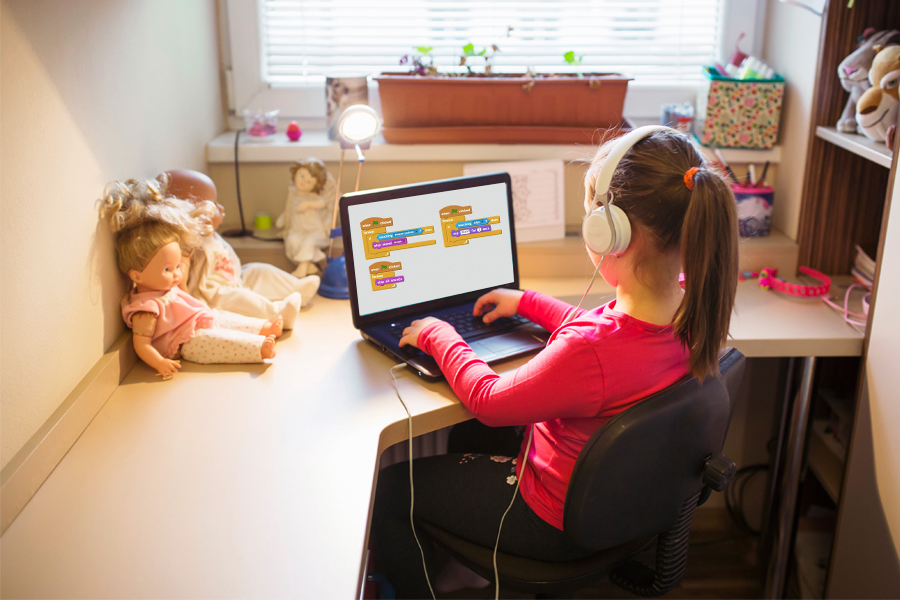
The government’s decision to bring coding classes for kids from class six onwards is a welcome and mandatory change in the school curriculum. By the sixth standard, kids grow more than capable of understanding various programming languages and using them to create their own apps and programs. Moreover, by that age, kids develop their aptitude and cognitive abilities to deal with complex problems so it only makes sense to introduce them with devices, programs, and concepts that improve upon their computational thinking and algorithmic intelligence. Coding, programming, robotics, and other such programs focus not only on making kids intelligent but also to have the capability to apply that intelligence to solve problems in a systematic manner.
As we mentioned earlier, kids grow capable of grasping the basic ideas of coding by the age of 7 and should, therefore, be introduced to the world of programming as early as possible.
Coming to the point of why kids should learn to code, we must first understand that coding and programming are not limited to computer use. As Steve Jobs once said, “I think everybody should learn how to program a computer and should learn a computer language because it teaches you how to think.” Coding develops your computational thinking and improves your problem-solving abilities. It also makes you more observant and patient in the face of problems.
Learning to code also allows one to realize their dreams, ideas, and concepts and bring them into the real world, which is a reward on its own. Children who love to code become more creative and confident in their approach compared to kids who have little to no coding experience. It also refines their Maths skills and gets them to perform better academically.
Lastly, since the world is moving towards a digital future, learning to code makes kids future-ready and successful in their career choices. The world we see is extensively dependent on technology and the upcoming years are only going to see more inclination towards AI, Machine Learning, and Information technology. Most of the jobs we know today will either go obsolete or entirely dependent on the use of technology. Therefore, teaching kids to code at an early age prepares them for the upcoming technology revolution so when they grow up they possess the necessary skills and attitude to become an active member of modern society.
In India, there is a lack of proper computer education for kids. It is not until students reach higher education that they are appropriately introduced to computer programs and languages. The government’s decision to bring coding classes from the sixth standard will not only improve upon that situation, but it will also make the students gain an interest in computer science and other relatable subjects.
